How to Select an Encoder for Harsh Industrial Environments
30.09.2026
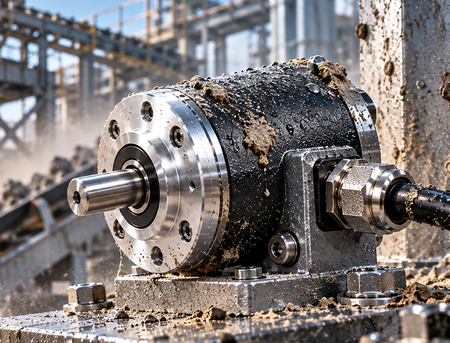
Industrial equipment often operates in extremely harsh environments, where dust, splashing water, cutting fluids, severe vibration, mechanical shock, extreme temperatures, and electrical interference are a daily reality. Selecting the right encoder for harsh environments requires a comprehensive assessment of environmental protection, readout technology, mechanical design, and electrical compatibility as a single system.
In this article, we will cover:
- How dust, water, vibration, temperature, and chemicals affect encoder selection.
- How to choose an appropriate IP rating.
- When optical or magnetic sensing is more practical.
- How mounting, shaft loads, and EMI affect reliability.
- Practical selection steps for demanding industrial applications.
What Is a Harsh-Environment Encoder?
A harsh-environment encoder is designed to provide reliable speed and position feedback despite exposure to conditions such as dust, water, vibration, shock, extreme temperatures, chemicals, or electrical interference.
Start With the Operating Environment

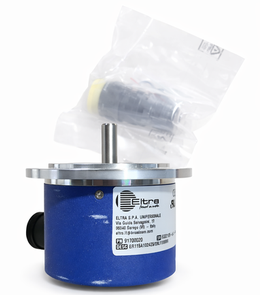
An assessment of the operating conditions should always be conducted before selecting a permit, PPR, or communication protocols. Dust and abrasive particles can penetrate poor seals, scratch optical discs, or seize rotating components. Water, high humidity, and coolants can cause short circuits and internal corrosion.
Exposure to aggressive cleaning agents can degrade standard rubber seals over time. Extreme heat or sudden temperature changes cause condensation to form inside the housing, while strong vibration can damage soldered joints and bearing raceways. Furthermore, nearby high-power electric motors and frequency converters generate strong electromagnetic interference.
Field insight. “Before I look at resolution, I want to know where the encoder will operate. Dust, water, vibration, and temperature can eliminate unsuitable options immediately.”
Choose the Right IP Rating
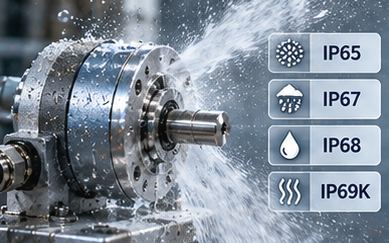
Ingress Protection (IP) ratings define the degree of enclosure sealing against solid objects and liquids in accordance with IEC 60529.
IP65
IP65 protection guarantees complete dust protection and resistance to water jets directed at the enclosure from any direction. This seal is suitable for most general industrial automation applications, conveyor lines, and woodworking machines where dust and occasional splashes of water are present.
IP67
Choosing a device such as an IP67 encoder provides complete protection against dust and withstands short-term immersion in water under strictly defined pressure and time conditions. Sensors with this protection are ideal for mobile construction equipment, agricultural machinery, and equipment subject to periodic washing or temporary submersion.
IP68
Installing a specialized IP68 encoder ensures reliable operation during prolonged immersion in water under the conditions specified by the equipment manufacturer. This level of protection is required for underwater vehicles, submersible pumps, marine winches, and mining equipment operating under constant hydrostatic pressure.
IP69/IP69K
The IP69 and IP69K ratings designate enclosures capable of withstanding high-temperature, high-pressure cleaning typical of the food, dairy, and pharmaceutical industries. During testing, the enclosure is exposed to high-pressure water jets at temperatures up to 80°C from close range.
|
Environment |
Protection to Consider |
|
General factory |
IP65 or application-specific equivalent |
|
Dusty machinery |
Dust-tight construction |
|
Outdoor equipment |
Dust + water protection |
|
Frequent washdown |
Suitable high-pressure water protection |
|
Immersion |
Appropriate immersion rating |
Optical vs Magnetic Encoders for Harsh Environments
When comparing optical vs magnetic encoders, engineers must balance resolution requirements with contamination resistance.
Optical encoders
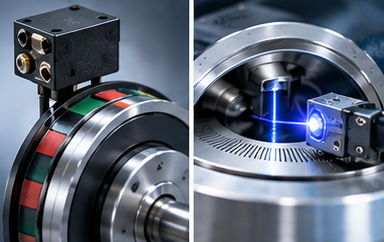
Optical encoders use an internal glass or plastic encoder disk, illuminated by an LED and read by an optoelectronic array:
- High resolution. Optical readout provides high angular resolution and clear signal edges;
- Precise signal. The encoded disks generate precise pulse trains for tight positioning loops;
- Enclosure dependence. A sealed enclosure protects the internal optics from dust in the external environment;
- Applications. Optical models are suitable for high-precision applications when properly sealed.
Magnetic encoders
Magnetic sensors detect position changes using a magnetized drum and Hall-effect sensors or magnetoresistive elements:
- Contactless principle. The magnetic field is read through solid partitions without a light beam.
- Dirt resistance. Dust and oil on the sensitive elements do not disrupt signal generation.
- Mechanical durability. Solid-state components easily withstand strong vibration and impact.
- Applications. Magnetic designs are ideal for heavy-duty equipment and outdoor use.
|
Factor |
Optical |
Magnetic |
|
High resolution |
Excellent |
Model-dependent |
|
Dust tolerance |
Depends on sealing |
Generally strong |
|
Vibration resistance |
Model-dependent |
Often strong |
|
Precision applications |
Common |
Application-dependent |
|
Heavy-duty applications |
Possible with suitable design |
Often practical |
Field insight. “I don’t automatically choose magnetic because an environment is dirty. I balance the required resolution against contamination, vibration, and protection requirements"
Check Vibration, Shock, and Shaft Loads
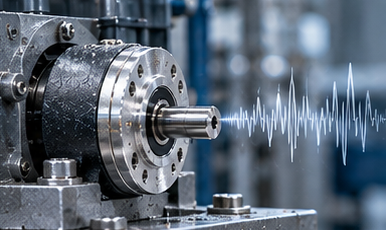
Installing a vibration-resistant encoder prevents internal component displacement and protects the bearings from shock loads:
- Constant vibration. Structural vibrations cause disk fatigue and contact wear.
- Mechanical shock. Sudden pulse loads can crack glass elements.
- Shaft load. Excessive radial and axial forces dramatically reduce bearing life.
- Shaft misalignment. Thermal expansion and installation errors place stress on the bearing assembly.
Consider the Full Temperature Range
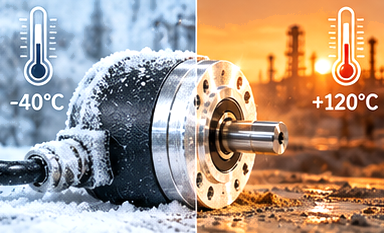
Operating temperature directly impacts component lifespan and signal stability. Selecting a high-temperature encoder rated for temperatures up to 120°C ensures that thermal effects from the motor or heaters will not disrupt signals:
- Minimum temperature. Cold conditions stiffen seals and increase rotational resistance.
- Maximum temperature. Overheating reduces LED output and destroys lubricant.
- Thermal cycling. Rapid temperature changes create internal condensation.
- Process radiation. Nearby heat sources raise the local temperature above ambient.
Practical example
Encoder mounted near an industrial motor: don’t select it using room temperature alone. Check the temperature around the encoder after the motor reaches normal operating conditions.
Protect Against Water, Dust, Oil, and Chemicals
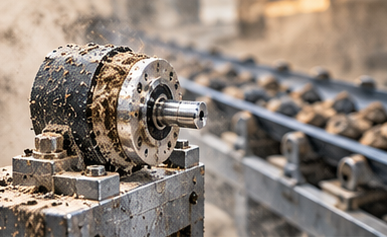
The IP rating of an encoder provides information about its protection against any ingress of matter, but the IP rating itself does not guarantee that the encoder would not be affected by oil, solvents, or chemicals. One needs to make sure that the material used for the encoders is compatible with the chemicals:
- Enclosure material. 316L stainless steel and anodized aluminum resist corrosion.
- Shaft seal. Viton and FKM seals prevent the penetration of oils and chemicals.
- Cable jacket. PUR and TPE materials prevent cable cracking due to contact with coolants.
- Connectors and entries. Sealed M12 connectors prevent liquid penetration through joints.
- Using a rugged encoder with reliable seals ensures that chemicals will not corrode the enclosure or destroy the seals.
Don’t Ignore Electrical Noise and EMI
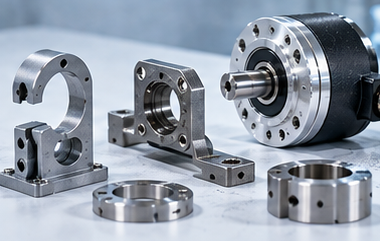
Electric motors, frequency converters, contactors, and welding machines are significant sources of electromagnetic interference. Unshielded cables will transmit the interference, leading to problems such as false pulses, incorrect counting, speed fluctuations, or failure of communication. Your choice should be:
- Shielded cable. Twisted pair cable with a dense copper shield blocks electrical interference.
- Shield grounding. 360-degree shield grounding eliminates ground loops.
- Differential signal. Protocols such as TTL and RS-422 effectively suppress common-mode interference.
- Cable routing. Separate routing of signal and power cables prevents interference.
Practical example
When an encoder is situated in the immediate vicinity of a VFD motor, mechanical protection is an insufficient measure. Signal type, shielding, grounding, and routing of the cables can sometimes play an equally important role as protection.
Match the Encoder to the Application
Selecting a sensor requires tailoring protection parameters to the specific hazards of different industries.

Mining and quarry equipment
Mining equipment operates in environments with high dust concentrations, strong vibration, rock impacts, and temperature fluctuations. Installing a heavy-duty encoder with reinforced bearings, a cast metal housing, and shock resistance exceeding 100g ensures continuous operation.
Food and beverage machinery
Food processing equipment is regularly washed under high pressure with alkaline and acidic solutions. IP69K protection, a 316L stainless steel housing, and Viton seals are required to prevent corrosion and bacterial growth.
Outdoor and mobile equipment
Construction machinery, cranes, and agricultural equipment are constantly exposed to weather, water washing, and road vibration. Selecting an industrial encoder requires consideration of resistance to UV radiation, salt fog, dirt, and a wide temperature range.
Heavy-duty conveyors
Trunk conveyors in bulk material terminals face abrasive dust, constant vibration, and high shaft loads. A dust-tight IP65/IP67 enclosure, robust bearings, and a reliable speed circuit are top priorities.
Chemical processing
Chemical plants expose sensors to solvent vapors, acidic gases, and aggressive liquids. Stainless steel, special PTFE/FKM seals, and explosion-proof construction protect equipment from corrosion and explosions.
Common Selection Mistakes
|
Mistake |
Possible Problem |
Better Approach |
|
Choosing by IP rating alone |
Failure from vibration/chemicals |
Evaluate the complete environment |
|
Ignoring chemical compatibility |
Seal or housing damage |
Check materials against actual media |
|
Ignoring vibration |
Premature failure |
Check vibration/shock ratings |
|
Incorrect coupling |
Bearing stress |
Allow for expected misalignment |
|
Exceeding temperature range |
Reduced service life |
Check actual operating temperature |
|
Poor cable routing |
Missed or false pulses |
Improve shielding and routing |
|
Excessive PPR |
Unnecessary signal frequency |
Match resolution to machine needs |
How to Select an Encoder for a Harsh Environment
A step-by-step engineering algorithm for selecting an encoder for harsh environments includes the following steps:
Measurement objective. Determine the need for speed, position, or direction monitoring.
- Contamination assessment. Identify all risks of exposure to dust, water, oils, and chemicals.
- IP class selection. Compare the degree of sealing with the risks of solid particle and liquid ingress.
- Operating temperatures. Consider air temperature, motor heating, and thermal cycles.
- Vibration and shock. Check maximum permissible mechanical load levels.
- Reading principle. Compare optical and magnetic technologies in terms of accuracy and dirt resistance.
- Resolution calculation. Select the required number of pulses without overloading the controller inputs.
- Shaft speed. Check that the maximum rotation speed complies with mechanical limits.
- Shaft load. Calculate the permissible radial and axial forces on the bearings.
- Shaft design. Choose between a solid shaft with a coupling or a hollow shaft.
- Electrical interface. Matching signal types (TTL, HTL, absolute) with PLC inputs.
- EMI protection. Use of shielded cables, grounding, and differential lines.
- Material resistance. Checking the housing, seals, and cable resistance to environmental conditions.
- Service life. Assessing the expected service life, bearing life, and ease of maintenance.
Expert insight. “When considering extreme conditions, my first question is not related to the encoder's resolution. My initial concern is its potential damaging influences – water, dirt, shock, heat, chemicals, or electrical noise – after which I check that its specifications match the machinery's needs for feedback.”
FAQ
What type of encoder is best for harsh environments?
Magnetic devices are ideal for high vibration, dust, and outdoor applications thanks to their non-contact design. Sealed optical models, however, remain the best choice when high angular resolution and accuracy are required.
Are magnetic encoders better for dirty environments?
Magnetic sensors are generally better suited for dirty conditions. Optical systems require a clean optical path, so their reliability in dirty environments depends entirely on the integrity of the housing seals.
Can optical encoders be used in dusty environments?
Yes, optical encoders operate reliably in dusty environments if they are equipped with a dust-proof housing with at least IP65 protection. Double shaft seals, robust metal construction, and sealed cable entries prevent small abrasive particles from entering the optical chamber.
What IP rating should an industrial encoder have?
A standard industrial encoder should have an IP65 protection rating. Equipment exposed to heavy water, precipitation, or regular pressure washing requires IP67, IP68, or IP69K ratings.
What is the difference between IP65, IP67, and IP68 encoders?
An IP65 enclosure protects the device from dust and jets of water from any direction. IP67 provides complete dust protection and withstands temporary immersion in water. IP68 protection is rated for continuous immersion in pressurized water, according to the manufacturer's specifications.
Does an encoder's IP rating mean it is chemically resistant?
No, the IP rating only indicates the degree of physical sealing against clean water and dust. It does not characterize the chemical resistance of the encoder and sealing materials to oils, solvents, acids, or detergents, which must be tested separately.
How does vibration affect encoder performance?
Vibration causes fatigue in optical disk materials, abrasion of internal contacts, deterioration of solder joints, and accelerated bearing wear.
How do I protect an encoder from electrical noise?
To protect signals from electromagnetic interference, use shielded twisted-pair cable, ensure 360° grounding of the shield, use differential TTL RS-422 drivers, and route signal lines separately from power cables.
What causes industrial encoders to fail prematurely?
The most common causes of premature failure are liquid penetration through damaged seals, bearing overload due to shaft misalignment, severe vibration, overheating, and electrical interference that distorts feedback signals.